Three seconds. That's how long the average buyer spends on a listing photo before deciding whether to scroll past it or click.
I know this because I've watched the behavior for years — first as a seller who couldn't understand why his perfectly nice condo sat for two months, then as someone who now shoots listings for a living. The pattern never changes. Buyers don't read your description first. They don't care about the school district yet. They see a thumbnail, their thumb hovers, and a decision happens in a blink.
What fascinates me is that most sellers know their photos matter. They just don't know which photos matter, or why. So they take twenty shots with a phone, pick the ones where the kitchen "looks bright," and wonder why showings are slow. The gap between "fine" and "clicked" is smaller than you'd think — and it's almost entirely about light, angles, and knowing what a buyer's eye does before their brain catches up.
Here's what actually attracts buyers, based on listings I've shot, ones I've watched succeed, and a few embarrassing early failures I'd rather forget.
Key takeaways
- The first photo is a thumbnail, not a portrait. It's judged on contrast and clarity at postage-stamp size.
- Light sells. Dark rooms read as "problem" even when there's no problem at all.
- The 20/60/20 rule of tonal balance is the fastest way to make an image feel professional without expensive gear.
- The "3-3-3 rule" people search for isn't one universal standard — I'll explain what it usually refers to and why it half-works.
- Decluttering removes more sales resistance than any lens or camera body ever will.
- Twilight shots and wide verticals pull clicks that daytime flat shots never do.
Why buyers judge your listing in three seconds (and how to win that window)
A buyer scrolling Zillow or Rightmove isn't studying your home. They're filtering. Your photo competes against fifty others in the same search grid, all roughly the same size, all in the same muted color palette. The one that wins is the one with the strongest tonal contrast — a bright, defined subject against a controlled background.
The thumbnail test
Before you post anything, shrink your favorite photo down to the size of a postage stamp. Can you still tell it's a living room? Can you see where the wall ends and the window begins? If the image turns into a gray smear, buyers will too.
This is why I tell sellers to shoot the brightest, most contrasting room as their first image — usually the living room or an open-plan kitchen with strong light. Not the front exterior unless the exterior is genuinely stunning. A flat, gray facade kills attention before a buyer ever sees the inside.
Lead with one emotion
Every winning listing photo triggers one feeling. Warmth. Space. Light. Order. Pick the feeling your home does best and lead with it. If you have a huge window and a good sunset, shoot the room at 5pm and let the light do the work. If your home is small but immaculate, shoot tight, clean, symmetrical compositions that say "well cared for."
I once shot a 700-square-foot apartment where the seller insisted on a wide shot of the tiny living room. It looked cramped. We reshot closer, from a lower angle, framing just the sofa and one window. Same room. It sold in nine days.
The 20 60 20 rule for balanced real estate photos
Here's a technical rule almost no listing guide mentions, and it's the single biggest upgrade a beginner can make.
The 20/60/20 rule in photography describes how tones should be distributed across a well-balanced frame: roughly 20% highlights, 60% midtones, and 20% shadows. In plain terms, most of your image should sit in the comfortable middle range, with bright areas and dark areas each taking a smaller, deliberate share.
When a photo breaks this balance, the eye gets uncomfortable. Blown-out windows and pitch-black corners push tone toward the extremes and the room feels chaotic. Flat, equally-lit walls with no shadow at all push everything into the middle and the space feels lifeless.
How to hit 20/60/20 without a light meter
- Turn off overhead lights. They cause hotspots and color casts. Use window light and floor lamps instead.
- Bracket your exposure. Shoot three frames — one normal, one brighter, one darker — and pick the one where shadows retain detail.
- Lift shadows in editing, but hold the highlights. If the window is a pure white rectangle with no view, you've gone too far.
- Check the histogram on your camera. You want a shape that rises in the middle, not two spikes at the edges.
I'll admit I ignored this rule for my first year. My photos looked "fine" — but flat. The moment I started controlling highlights and shadows on purpose, my clients started commenting that the rooms "felt bigger." They didn't. The tonal balance just let their eyes relax.
What camera settings support this
For interior real estate, a reasonable starting point is f/8, ISO 200, and a tripod. The narrow aperture keeps both the foreground sofa and the back wall sharp. Low ISO keeps noise out of the shadows, which matters because you'll be lifting them. A tripod lets you shoot long exposures so window light and interior light can blend without one overpowering the other.
On a phone, you can approximate the same effect by enabling HDR, tapping to expose for the window, then lifting shadows in post. More on phones in a moment.
What is the 3-3-3 rule in real estate?
You may have seen the "3-3-3 rule" floating around real estate circles, and it's worth being honest about: it isn't one official standard. Depending on who's talking, it refers to different things.
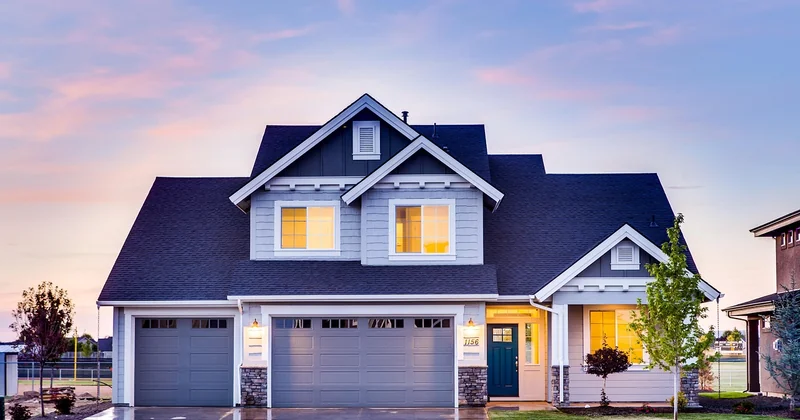
The most common version I've encountered applies to buyer behavior: buyers decide within 3 seconds whether to keep looking, they'll view roughly 3 photos before forming an opinion of a listing, and they'll compare about 3 properties before making an offer. Another version applies it to photography workflow: shoot 3 angles per room, from 3 heights, with 3 lighting setups.
Which one is "correct"? Honestly, neither is gospel. But the underlying idea is useful: small numbers of high-impact elements do most of the work. You don't need forty photos. You need three that stop the scroll, and the rest can support them.
How I apply it
When I shoot a listing, I make sure at least three images are genuinely scroll-stopping: the best living space, the best light-filled moment, and a signature shot (twilight exterior, a great kitchen, a view). Everything else is supporting cast. If the first three don't sell the property, the other twenty won't either.
The clutter trap that costs you showings
Every seller hears "declutter" and nods. Almost none of them actually do it at the level that matters.
The problem isn't mess. It's personal traces. Family photos, fridge magnets, the cereal boxes on the counter, the jacket on the chair, the dog bowl by the door. Buyers don't consciously reject these things. They just can't project themselves into the space when someone else's life is visibly occupying it.
I learned this the hard way years ago. I shot a beautiful Victorian terrace that had been staged well in every room except the study, which was packed with the owner's books and framed certificates. Every buyer who walked through — I asked a few afterward — said the study felt "small." It wasn't. It was just crowded with someone else's identity.
- Clear every countertop in the kitchen. No exceptions, not even the coffee maker.
- Remove all personal photos, certificates, and fridge art.
- Hide bathroom products entirely — bottles, toothbrushes, towels that don't match.
- Take the bins out of frame. Yes, even the nice ones.
- Remove pet items. Bowls, beds, toys, all of it.
- Strip bedding down to neutral tones. Bright duvets dominate photos.
- Open every curtain and blind you can. Light trumps coziness every time.
Weeks before a shoot, I tell sellers to live like they're already gone. Nothing on surfaces, nothing that says "someone else lives here." It sounds extreme. It works.
Can you take real estate photos with your phone?
Yes. I've shot listings with a phone when a client needed an emergency reshoot and I had nothing else on me. Two of those images ended up as the lead photo on the final listing.

But a phone in the wrong hands produces the worst listing photos on the market — more than a bad DSLR ever does. The reason isn't the sensor. It's the wide-angle distortion, the aggressive HDR that flattens rooms, and the automatic color grading that turns warm oak cabinets into an orange smear.
Phone photography that actually works
- Shoot in landscape orientation for interiors. Vertical shots squeeze rooms.
- Keep the phone at chest height, not eye height. Aim slightly downward or level.
- Hold the phone perfectly vertical — even a slight tilt makes walls lean inward.
- Stand in a corner and shoot diagonally across the room. This makes spaces feel larger.
- Turn off the flash. Always.
- Use a tripod and the timer. Phone stabilization still wobbles in low light.
If you're photographing a listing yourself and you're serious about attracting buyers, the phone will get you 70% of the way. The last 30% — the light blending, the tonal control, the composition polish — is where professional gear and experience actually pay off.
How to get more clients as a real estate photographer
For anyone on the other side of this article — the photographer, not the seller — the client problem is different. You're not fighting clutter and bad light. You're fighting invisibility. Every agent in your city already knows someone who "does photos."
What works, in my experience, is narrower than most marketing advice suggests:
- Shoot two agents for free, exceptionally well. Not portfolio pieces — actual live listings. Deliver in 12 hours. They'll show their colleagues.
- Price per listing, not per hour. Agents think in transactions, not time. A flat rate reduces friction to zero.
- Deliver a vertical crop for social. Agents need Instagram-ready images. Give them two aspect ratios of every shot and you'll be their default.
- Never miss a deadline. Listings go live on a schedule. A missed delivery is a lost client, no matter how beautiful the work.
- Show results, not photos. "This sold in 11 days" beats any gallery on your website.
The photographers I know who consistently earn well don't chase volume. They build a small roster of loyal agents — often five to ten — who call them for every listing. That's a far more stable business than trying to serve fifty strangers.
How many photographers make over $300,000 a year?
Not many, and it's worth being honest about that. Real estate photography is typically a solo business, and most photographers earn a comfortable but modest income from it. The ones who break into the $300,000+ range usually do it by one of three paths: scaling into a small team with junior shooters and an editor, moving into high-end architectural work where a single shoot bills several thousand dollars, or adding adjacent services like video walkthroughs, drone, floor plans, and virtual staging to each listing.
The pure single-shooter model, no matter how talented, tends to cap out below that number simply because there are only so many hours in a week.
The details buyers actually notice
After enough listings, you develop a strange sense of what buyers really look at. It isn't what sellers think.

| What sellers obsess over | What buyers actually notice |
|---|---|
| Perfect wall paint color | Whether the room feels light or dark |
| Showcasing new appliances | Whether the kitchen looks clean and open |
| Getting every room in the set | Whether the first three photos made them want more |
| Straightening the cushions | Whether the floor plan makes sense from the images |
| Selecting the "best" shot of each room | Whether any single image made them feel something |
The pattern is consistent. Buyers respond to feel first, then logic. Your photos aren't a documentary of the property — they're an argument for it. Every frame should be making that argument visually, not just factually.
The one thing I wish I had known earlier
For my first two years, I treated photography as a technical problem. Better lens, better tripod, better edits. Those things matter, but they're not the point.
The listings that sell fastest — and I've now watched dozens — are the ones where the photographer asked one honest question before ever pulling out a camera: What feeling does this home give someone who's never seen it?
Light sells. Space sells. Order sells. Emotion sells. None of those come from a checklist. They come from standing in a room, looking at it the way a stranger would, and asking what that stranger needs to see to want to live there.
If you can answer that, the gear matters less than you think. If you can't, no amount of equipment will save the listing — and no buyer will ever scroll back up to find out what they missed.